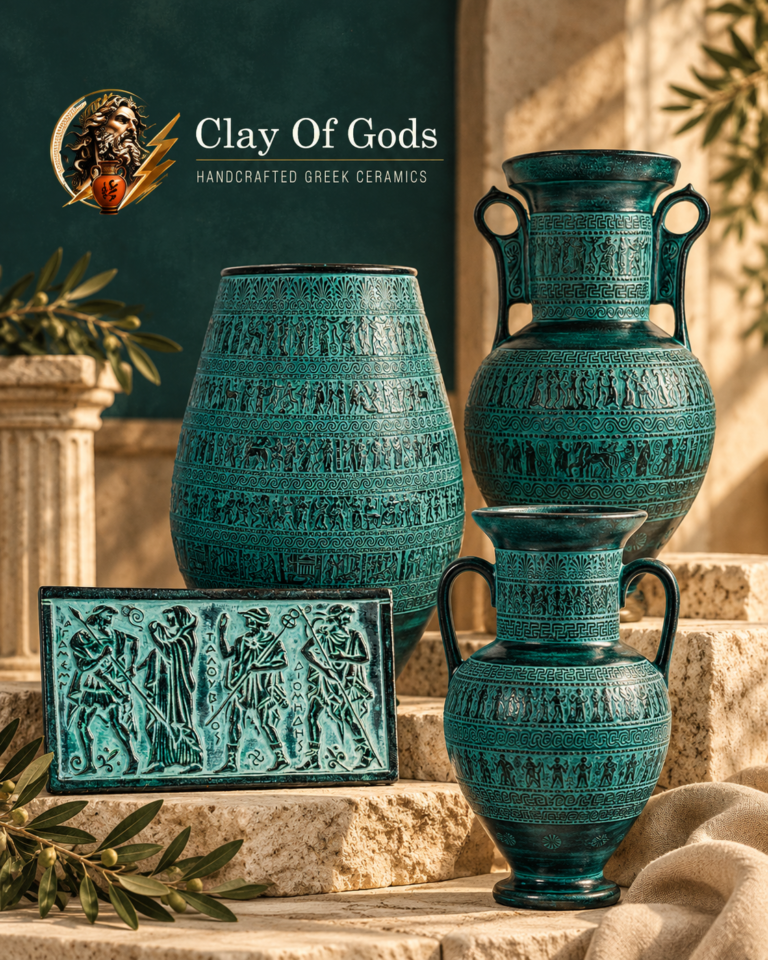
The Greek oinochoe was one of the most common pouring vessels used in the ancient Greek world.
Elegant, practical and produced in many different shapes, the oinochoe was primarily associated with serving wine. Its characteristic single handle and carefully shaped mouth made it particularly suitable for pouring liquids into drinking cups.
Like many forms of Ancient Greek pottery, however, the oinochoe became much more than a purely functional object. Ancient craftsmen decorated these vessels with geometric patterns, mythological figures and scenes from everyday life.
Today, the oinochoe remains one of the most distinctive forms of classical Greek ceramics.
What Is an Oinochoe?
An oinochoe is an Ancient Greek jug traditionally used for pouring wine.
The name is associated with the Greek words for wine and pouring, reflecting the vessel’s original purpose.
While many different forms existed, an oinochoe usually has several recognisable characteristics:
- A single handle
- A relatively narrow neck
- A rounded or elongated body
- A pouring mouth
- A stable foot or base
Some examples feature a characteristic trefoil-shaped mouth designed to help control the flow of liquid.
What Was an Oinochoe Used For?
The oinochoe was primarily a serving vessel.
During a Greek symposium, wine and water were mixed in a large krater. The prepared wine could then be transferred into smaller vessels such as oinochoes and poured into individual drinking cups.
This created a functional relationship between several different types of Greek pottery.
The krater was used for mixing, the oinochoe for pouring, and cups or kylikes for drinking.
This specialised use of different vessel forms demonstrates how closely pottery was connected to everyday social customs in Ancient Greece.
The Oinochoe and the Greek Symposium
The symposium was an important social gathering in the ancient Greek world.
Participants gathered to drink wine, converse, listen to music and take part in entertainment or intellectual discussion.
Pottery played an essential role in these gatherings.
Large vessels such as kraters stood at the centre of the drinking ritual, while oinochoes allowed wine to be served from the communal mixture into individual cups.
Because these objects were constantly visible and handled during the gathering, their appearance and decoration were also important.
Different Oinochoe Shapes
Ancient Greek potters produced numerous variations of the oinochoe.
Some were tall and slender, while others had broad rounded bodies.
Mouth shapes also varied considerably. Certain examples featured a round opening, while others used the distinctive trefoil mouth often associated with Greek wine jugs.
Handles could rise elegantly above the shoulder of the vessel before connecting near the rim.
These variations allowed craftsmen to experiment with proportion while maintaining the fundamental purpose of the form.
Oinochoes as Decorative Art
Like amphorae and kraters, oinochoes offered ancient potters a surface for artistic decoration.
Depending on the period and style, decoration could include:
- Geometric patterns
- Greek key motifs
- Gods and mythological figures
- Warriors
- Animals
- Dionysian imagery
- Scenes of daily life
The curved surface of the vessel meant that decoration had to work together with the shape of the pottery.
This relationship between form and imagery became one of the defining characteristics of Ancient Greek ceramic art.
Black-Figure and Red-Figure Oinochoes
Oinochoes were produced during periods when both black-figure and red-figure pottery techniques flourished.
In black-figure pottery, figures were represented in dark silhouette against the natural reddish colour of the clay.
Details could then be incised into the figures.
Red-figure pottery reversed this relationship, leaving the figures in the colour of the clay while the surrounding background became dark.
This technique allowed artists greater freedom when depicting movement, anatomy and clothing.
Oinochoes decorated using these methods demonstrate how even practical serving vessels could become highly sophisticated works of art.
Wine, Dionysus and Greek Pottery
Wine was closely connected with Dionysus, the Greek god associated with wine, celebration and theatre.
For this reason, pottery connected with drinking often included Dionysian imagery.
Vines, grapes, satyrs, maenads and representations of Dionysus could appear on vessels used during drinking rituals.
The decoration therefore created a direct relationship between the function of the pottery and the mythology associated with wine.
You can explore more of these themes in our guide to Ancient Greek pottery symbols and motifs.
Oinochoe, Amphora and Krater: What Is the Difference?
Although these vessels can look similar at first glance, they had different principal functions.
An amphora typically has two handles and was commonly used for storing or transporting goods such as wine or olive oil.
A krater is a large open vessel used for mixing wine with water.
An oinochoe normally has one handle and was designed for pouring wine or other liquids.
Understanding these differences makes it much easier to recognise the major forms of Ancient Greek pottery.
Read our guide to Ancient Greek pottery types for a broader explanation of amphorae, kraters, oinochoes and rhytons.
The Oinochoe in Contemporary Greek Ceramics
The elegant proportions of the oinochoe continue to inspire modern ceramic craftsmen.
Contemporary interpretations may preserve the recognisable single-handle silhouette while introducing different finishes, relief decoration and colours.
At Clay Of Gods, our Greek Oinochoes draw inspiration from classical Greek pottery while being individually handcrafted in Greece.
Small variations in surface, colour and finish form part of the character of handmade ceramic work.
Handmade Greek Oinochoes
Clay Of Gods continues a family ceramic tradition that began in 1950.
Our collections reinterpret forms and decorative themes inspired by Ancient Greek ceramics, mythology and cultural heritage.
The oinochoe represents this tradition particularly well: a practical ancient form whose proportions remain visually distinctive thousands of years later.
Explore our collection of Greek Oinochoes or discover our complete range of handmade Greek ceramics.