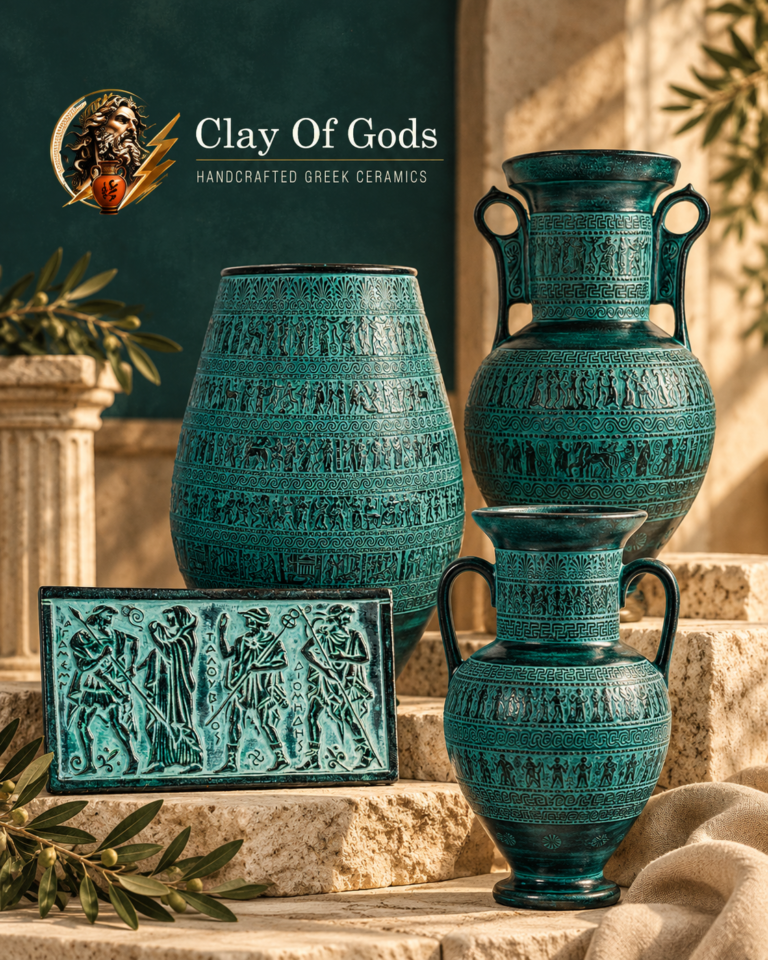
The Greek amphora is one of the most recognisable forms of Ancient Greek pottery. With its distinctive two handles, narrow neck and balanced body, the amphora became both a practical vessel and an important canvas for Greek art.
Thousands of amphorae have survived from the ancient Mediterranean world, providing historians and archaeologists with valuable information about trade, everyday life, mythology, religion and artistic traditions.
Today, the amphora remains an enduring symbol of Ancient Greece and continues to inspire contemporary Greek ceramic craftsmanship.
What Is a Greek Amphora?
An amphora is a ceramic vessel traditionally characterised by two vertical handles positioned on either side of the body.
The name comes from the Ancient Greek word amphoreus, referring to a vessel that could be carried using handles on both sides.
Although amphorae existed in many different shapes and proportions, most share several recognisable characteristics:
- Two handles
- A narrow or defined neck
- A rounded or elongated body
- A stable base or pointed lower section depending on its purpose
Different forms developed over centuries according to their function, geographical origin and artistic period.
What Were Amphorae Used For?
Amphorae were primarily practical objects.
Throughout the ancient Greek world they were commonly used to store and transport important goods, particularly:
- Wine
- Olive oil
- Grain
- Dried foods
- Other agricultural products
Their shape made them suitable for transportation by ship, while their narrow neck helped control pouring and reduce spillage.
Some transport amphorae had pointed bases rather than flat ones. These could be packed closely together aboard ships or supported in sand and storage racks.
Because pottery styles varied between regions and periods, archaeological amphorae can also provide evidence about ancient Mediterranean trade routes.
Amphorae as Works of Art
Not every amphora was simply a storage container.
Many Greek amphorae were carefully decorated and served ceremonial, commemorative or prestigious purposes.
Ancient potters and painters transformed the surface of the vessel into a storytelling medium.
Decorative scenes could depict:
- Greek gods and goddesses
- Heroes and mythology
- Warriors and battles
- Athletic competitions
- Religious ceremonies
- Banquets and celebrations
- Scenes from everyday life
These images have become some of the most important surviving sources for understanding the culture and visual world of Ancient Greece.
Black-Figure and Red-Figure Amphorae
Two of the best-known decorative techniques in Ancient Greek pottery are black-figure and red-figure painting.
Black-Figure Pottery
In the black-figure technique, figures were painted using a clay slip that became dark during firing. Details were then incised into the surface.
The technique became especially important in Athens during the Archaic period.
Red-Figure Pottery
Red-figure pottery reversed this visual relationship. The background became dark while the figures retained the reddish colour of the clay.
This allowed artists greater freedom when depicting anatomy, clothing and movement.
Both techniques produced some of the most celebrated examples of Ancient Greek ceramic art.
Amphorae and Greek Mythology
Mythology was one of the most important themes represented on Greek pottery.
Amphorae frequently portrayed stories involving figures such as Zeus, Athena, Apollo, Dionysus, Heracles and other gods and heroes.
These scenes were not simply decorative.
For ancient viewers, mythology formed part of religion, cultural identity and collective storytelling. A ceramic vessel could therefore combine everyday function with stories and symbols understood throughout the Greek world.
This relationship between pottery and mythology remains a major source of inspiration for our handmade Greek amphorae today.
Panathenaic Amphorae
Among the most famous examples were Panathenaic amphorae.
These large decorated vessels were awarded as prizes during the Panathenaic Games held in honour of the goddess Athena.
They were traditionally filled with valuable olive oil and decorated with characteristic imagery, including Athena and scenes representing the athletic event for which the prize was awarded.
They demonstrate how an amphora could simultaneously serve as a container, a prestigious prize and an artistic object.
Why Is the Amphora Shape So Recognisable?
Part of the amphora’s enduring appeal comes from its proportions.
The combination of the neck, shoulders, rounded body and symmetrical handles creates a visually balanced silhouette.
The shape is immediately associated with the classical Mediterranean world even when interpreted by modern craftsmen.
Its large surface also provides space for relief decoration, painted motifs and representations of mythology.
This makes the amphora particularly suitable for decorative ceramic work.
The Amphora in Modern Greek Ceramics
Contemporary ceramic artists continue to reinterpret the amphora rather than simply reproducing archaeological pieces.
Traditional shapes may be combined with different finishes, textures, relief work and colours while retaining the fundamental proportions that make the amphora recognisable.
At Clay Of Gods, our ceramic amphorae are handmade in Greece and inspired by Ancient Greek pottery, mythology and classical decorative traditions.
Pieces such as our Χειροποίητος Κεραμικός Αμφορέας Αρχαιοελληνικής Έμπνευσης με Ανάγλυφες Μυθολογικές Παραστάσεις reinterpret the traditional form through sculpted mythological scenes and aged artisan finishes.
Handmade Greek Amphorae at Clay Of Gods
Clay Of Gods continues a family ceramic tradition that began in 1950.
Our amphorae are part of a wider collection of handmade ceramics inspired by the forms, imagery and stories of Ancient Greece.
Rather than treating Greek heritage simply as decoration, our work draws from a ceramic tradition that has connected clay, craftsmanship and storytelling for thousands of years.
Explore our complete collection of Greek Amphorae or discover more handmade Greek ceramics inspired by the art and mythology of Ancient Greece.