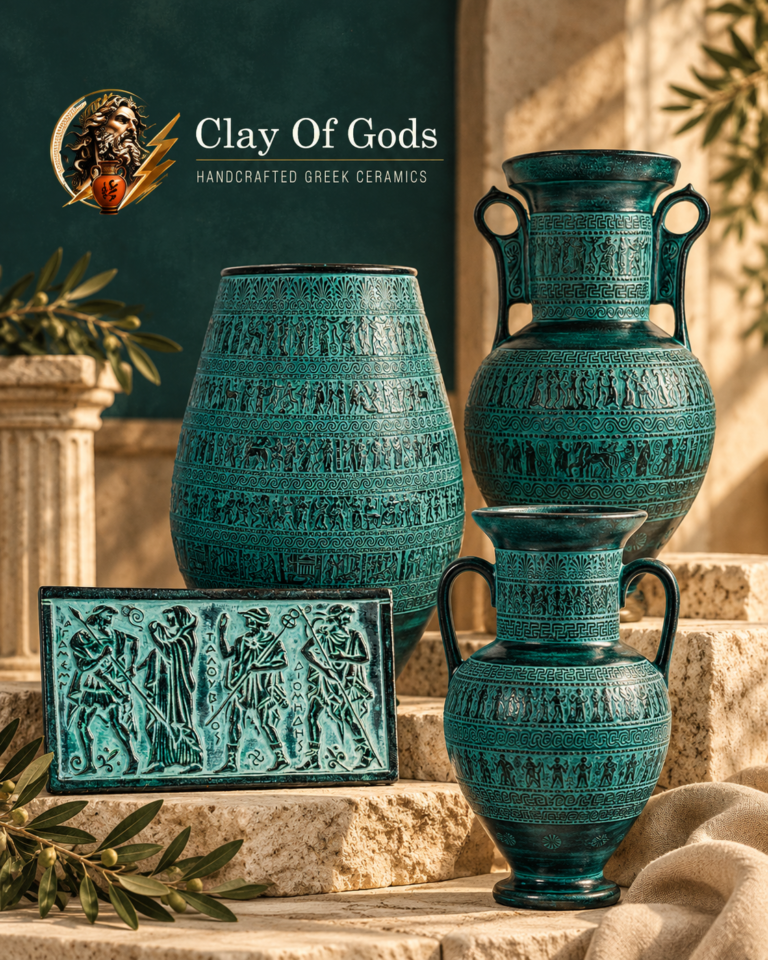
The Greek krater was one of the most important vessels associated with drinking and social life in Ancient Greece.
Large, open and often richly decorated, kraters were traditionally used to mix wine with water before it was served to guests.
Their prominent position during social gatherings also made them ideal surfaces for artistic decoration, with scenes depicting mythology, gods, heroes, celebrations and everyday life.
Today, the distinctive form of the krater remains an important part of the visual language of Ancient Greek pottery.
What Is a Greek Krater?
A krater is a large ceramic vessel designed primarily for mixing wine and water.
Unlike amphorae, which were generally used for storage and transportation, kraters usually had broad openings that allowed liquids to be mixed and served easily.
They were often placed in a central position during gatherings, with wine then transferred from the krater into smaller serving and drinking vessels.
The combination of function, scale and decoration made the krater one of the most impressive forms of Ancient Greek ceramic art.
Why Did the Ancient Greeks Mix Wine With Water?
In Ancient Greek social culture, wine was commonly diluted with water before drinking.
During a symposium—a social gathering centred around drinking, conversation, music and entertainment—the krater played a central role.
The strength of the mixture could vary, and the preparation of wine formed part of the customs and organisation of the gathering.
This meant that the krater was not simply another container. It was closely connected to the social ritual of communal drinking.
The Krater and the Greek Symposium
The symposium was an important feature of social life in many parts of the ancient Greek world.
Guests gathered to drink, converse, listen to music, discuss ideas and participate in entertainment.
At the centre of this activity stood the krater.
Wine and water were mixed in the vessel before attendants transferred the drink into cups and distributed it among the participants.
Because of its central position, the krater could become one of the most visually impressive objects in the room.
Different Types of Greek Kraters
Ancient Greek potters developed several distinctive krater forms.
Although all served broadly similar purposes, their shapes, handles and proportions differed considerably.
Column Krater
The column krater takes its name from its distinctive handles, which rise from the shoulders of the vessel toward the rim.
Its broad body and structured shape provided substantial surfaces for painted decoration.
Column kraters are frequently associated with both black-figure and red-figure pottery.
Calyx Krater
The calyx krater has a lower body that expands upward toward a broad opening.
Its shape resembles the calyx of a flower, which gives the vessel its modern name.
The wide upper surface provided artists with a large area for complex mythological and figurative scenes.
Bell Krater
The bell krater has a body that resembles an inverted bell.
Its relatively simple silhouette and broad mouth made it both practical and visually elegant.
Bell kraters became particularly prominent in classical Greek pottery.
Volute Krater
The volute krater is distinguished by large handles that curve into spiral forms known as volutes.
These handles give the vessel a monumental and highly decorative appearance.
Volute kraters were often elaborate objects and could feature extensive painted scenes and ornamental details.
Kraters as Works of Art
Like many forms of Ancient Greek pottery, kraters became important surfaces for visual storytelling.
Their large bodies allowed artists to create detailed compositions involving numerous figures.
Common subjects included:
- Greek gods and goddesses
- Heroes and mythological stories
- Dionysus and scenes associated with wine
- Warriors and battles
- Athletic competitions
- Banquets and celebrations
- Religious and ceremonial scenes
These images transformed an everyday functional object into an important work of art.
Dionysus and the Culture of Wine
Dionysus, the Greek god associated with wine, celebration and theatre, naturally appears frequently in pottery connected with drinking.
Kraters could feature Dionysus accompanied by satyrs, maenads and other mythological figures associated with his world.
Such imagery connected the physical purpose of the vessel with the mythology surrounding wine and celebration.
The relationship between function and decoration is one of the most fascinating aspects of Ancient Greek pottery.
Black-Figure and Red-Figure Kraters
Kraters were decorated using some of the best-known techniques of Greek pottery.
In black-figure pottery, dark figures were created against the natural reddish colour of the clay, with details often incised into the surface.
Red-figure pottery reversed the relationship, leaving the figures in the natural clay colour while the background was darkened.
The red-figure technique gave artists greater flexibility when representing anatomy, movement and clothing.
Because kraters offered such large surfaces, they became particularly impressive examples of both styles.
Kraters and Mythological Storytelling
The large surface of a krater allowed a potter or painter to depict scenes involving several characters.
Myths featuring gods, heroes and dramatic events could therefore unfold across the vessel almost like a visual narrative.
For modern viewers, these surviving objects provide an extraordinary connection with how ancient Greeks imagined familiar mythological stories.
They also reveal details about clothing, armour, rituals, music and social customs.
Kraters in Contemporary Greek Ceramics
The krater remains an important source of inspiration for contemporary ceramic craftsmen.
Modern interpretations may retain the broad proportions and classical silhouette of the ancient form while introducing different colours, relief decoration and artisan finishes.
At Clay Of Gods, our Greek Kraters draw inspiration from Ancient Greek ceramic traditions while being individually handcrafted in Greece.
Their forms and decorative details connect contemporary ceramic work with a tradition that reaches back thousands of years.
From Ancient Function to Modern Decorative Art
Ancient kraters were created primarily as functional vessels.
Today, their scale, proportions and historical associations make them especially powerful decorative objects.
The same qualities that allowed ancient craftsmen to cover kraters with elaborate mythological scenes now make the form particularly suitable for statement ceramic pieces.
At Clay Of Gods, we continue to explore this connection between ancient forms and contemporary craftsmanship.
Discover our collection of Greek Kraters or explore our complete range of handmade Greek ceramics inspired by Ancient Greek art, history and mythology.